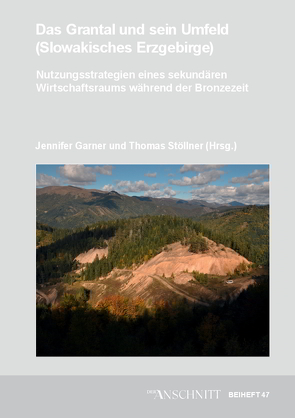
Das Slowakische Erzgebirge in der Mittelslowakei, welches zu den Westkarpaten gehört, zählt zu einer der wichtigsten metallogenetischen Zonen Mitteleuropas. Die Frage nach einer prähistorischen Nutzung war aufgrund der reichhaltigen Metallfunde und Metallurgienachweise in den letzten Jahrzehnten öfter Gegenstand unterschiedlicher Untersuchungen, konnte aber wegen der komplexen, mehrphasigen Lagerstättengenese, auch im Vergleich mit den Lagerstätten Serbiens / Bulgariens sowie der Alpen, nur eingeschränkt beantwortet werden. Grundsätzlich zeigten die Untersuchungen jedoch die Bedeutung der slowakischen Lagerstätten als Rohstofflieferant, neben den Ostalpen, seit dem 4. Jt. v.Chr. Dennoch mussten Fragen nach der Nutzung der Montanregion selbst sowie nach der Organisation der Ausbeutung der Lagerstätten sowie deren positive Identifizierung als Rohstofflieferant bisher offenbleiben. Auch die Handelswege zwischen der Montanregion und ihrem Umfeld sowie die Einbindung der bekannten Großsiedlungen in den Flusstälern und überhaupt die Struktur der kupfer- und bronzezeitlichen Siedlungsmuster sind größtenteils ungeklärt. Montanarchäologische Forschungen blieben eher im Hintergrund und Vorarbeiten erfolgten nur in Špania Dolina in den 1970er Jahren, wo die auf den spätmittelalterlich-neuzeitlichen Halden verteilten Schlägel- und Keramikfunde eine kupferzeitliche bis bronzezeitliche Nutzung nahelegen. Im Rahmen eines Verbundprojektes, die wirtschaftlichen Grundlagen der frühbronzezeitlichen Besiedlung im Grantal und Žitavatal zu untersuchen, wurde das Deutsche Bergbau-Museum Bochum eingeladen, sich an der montanarchäologischen Erforschung des westlichen slowakischen Erzgebirges zu beteiligen. Es folgten metallurgische und archäologische Untersuchungen zur Metallverarbeitung der Siedlung Fidvar bei Vràble sowie auf ihre umgebende Mikroregion. Einen weiteren Schwerpunkt bildeten montanarchäologische Prospektionen sowie Ausgrabungen der potentiell bronzezeitlich genutzten Erzlagerstätten bei Banská Bystrica in L’ubietová und Poniky. Schließlich stand die Kupferlagerstätte von Špania Dolina [Herrengrund], welche aufgrund von Steinschlägelfunden und Keramikfunden in Piesky [Sandberg] bereits seit der Kupferzeit ausgebeutet worden ist im Fokus der Geländearbeiten. Die Ergebnisse dieser Untersuchungen werden in diesem Band vorgestellt.
The Slovakian Ore Mountains in central Slovakia, which are part of the Western Carpathians, are one of the most important metallogenic regions in central Europe. Over the last decades, the question of their prehistoric use was addressed in several studies, given the rich metal finds and indications of metallurgy, but could only partly be answered due to the complex, multi-phase genesis of the ore deposits, also in comparison to the deposits in Serbia / Bulgaria and the Alps. However, at a general level these studies succeeded in showing the importance of the Slovak deposits as raw material sources from the 4th millennium B.C. onwards, alongside the eastern Alps. Nevertheless, questions concerning the use of the area itself, the organisation of deposit exploitation and the their positive identification as raw material sources have hitherto had to remain open. In addition, the trade routes between the mining area and its surroundings, as well as the integration of the known large-scale settlements in the river valleys and in general the structure of Copper and Bronze Age settlement patterns remain largely unaddressed. Research into mining archaeology has remained somewhat in the background, and initial work was only carried out in Špania Dolina in the 1970s, where finds of mallets and pottery on late medieval and early modern waste dumps suggested use in the Copper and Bronze Ages. Within the framework of a collaborative project focusing on the economic basis of the Early Bronze Age settlement of the Žitava valley, the Deutsches Bergbau-Museum Bochum was invited to contribute to the mining archaeological investigation of the western Slovak Ore Mountains. This was followed by metallurgical and archaeological research on metalworking in the settlement of Fidvar near Vràble and the surrounding micro-region. A further focus was formed by mining archaeological prospection and the excavation of the ore deposits near Banská Bystrica in L’ubietová and Poniky, which were possibly used in the Bronze Age. Finally, the copper deposit of Špania Dolina [Herrengrund] was the centre of targeted fieldwork, as stone mallet and pottery finds from Piesky [Sandberg] indicated its exploitation since the Copper Age. This volume presents the results of our investigations.
Aktualisiert: 2022-11-03
> findR *
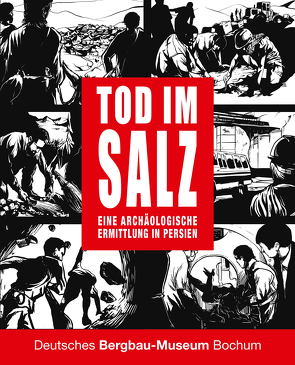
Als man im Winter 1993 die ersten Mumienteile im Salzberg von Chehrãbãd –Douzlãkh in Iran fand, war die Tragweite der Funde noch nicht klar; erst über 10 Jahre später gelang mit neuerlichen Mumienfunden eine erste montanarchäologische Ausgrabung und später die Entwicklung eines internationalen Forschungsprojektes. Dessen Ergebnis ist die Geschichte eines verunglückten Bergarbeiters im antiken Persien. Die Umstände seines Todes werden durch Funde und interdisziplinäre Forschungen in diesem Band erstmalig einer breiten Öffentlichkeit präsentiert.
Es erschließt sich dem Leser und Besucher der gleichnamigen Ausstellung ein bemerkenswertes Lebensbild der antiken Arbeitswelt vor ca. 2.400 Jahren. 30 Beiträge schildern den Stand der Forschung zum Salzbergbau im iranischen Salzbergwerk und zu anderen vergleichbaren Fundorten weltweit. Katalog und Ausstellung präsentieren erstmals eine größere Zahl von Funden aus der Lebenswelt der Bergleute.
Berichtet wird von Produktionsverfahren und Unglücken, dem Gesundheitsstatus und der Ernährung der Bergleute, wo und unter welchen Umweltbedingungen sie lebten und wohnten und schließlich von den Einschätzungen und dem Blickwinkel einer integrierten archäologischen Forschung auf alte Gesellschaften.
Als Besonderheit erzählt die Graphik Novel des iranischen Zeichners Sasan Saedi in lebendigen Bildern den letzten Lebenstag des um 400 v.Chr. verunglückten achämenidischen Arbeiters, „Salzmann 4“, der kurz nach seiner Ankunft am Salzbergwerk bei einem Grubenverbruch erschlagen wurde. Hier wird seine Geschichte wieder lebendig!
Aktualisiert: 2023-04-15
> findR *
Thanks to its extensive ore deposits, the Siegerland has a rich mining and smelting history, whose beginnings date back to the Pre-Roman Iron Age. Large-scale exploitation of ores in the region possibly began as early as the 5th century B.C. and was especially intense from the 3rd to the end of the 1st century B.C., when an economic region focusing on steel production developed. Given the number and state of preservation of sites connected to metallurgy, as well as the degree of specialisation of this mining landscape, the Siegerland can be counted among the most important production areas of Iron Age central Europe. A co-operative project between the Deutsches Bergbau-Museum Bochum, the Ruhr-University Bochum and the LWL-Archäologie für Westfalen, Olpe office, funded by the Deutsche Forschungsgemeinschaft, has explored the Iron Age mining landscape of the Siegerland. The project focused on the reconstruction of production chains, from iron ore to the finished product, as well as on the economic area itself and its development. This was achieved through large-scale surveys, geophysical prospection and archaeological excavation of selected sites. In addition, we carried out archaeometallurgical analyses on production residues and the ores themselves, as well as archaeobotanical and geoarchaeological investigations in order to reconstruct the natural landscape. This publication presents the results of the archaeological surveys, excavations and mapping. The work of the project team is considerably broadened through the analysis of prior excavations and maps, beginning with late 19th century work. Most of these investigations could be included and are here published for the first time.
Aktualisiert: 2020-12-24
> findR *
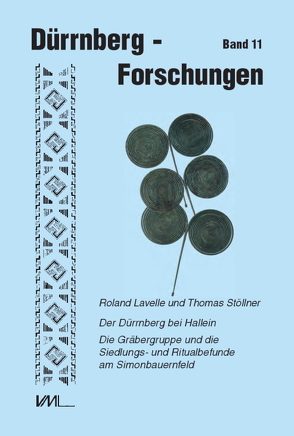
After the cemeteries published in DF 5-10 the seventh and last individual volume presents the evidence from Simonbauernfeld north-west of the church, which was excavated in 1984 and 1987 with Th. Stöllner being a member of staff. This very small, but rich cemetery of thirteen graves stands out for its complex nature with ritual activity in the spaces between graves, several graves of the initial stages of occupation, and a particular plenty of so-called Hallstatt daggers supporting - together with other imported goods - the westerly and southerly contacts of the Dürrnberg people. It also yielded important information on the topics of burial rites, including considerable manipulation of graves and a potential cult of ancestors, the narrow interlocking of grave and settlement structures, as well as individual graves of the Middle La Tène period. Features such as a platform with terrace walls and remains of commensal events or prominent stone settings [circle, cone] attest a memorial site of the 6th to 1st century B.C. For the overall interpretation of the some 400 graves of the Dürrnberg with far more individuals the concluding final publication is to follow.
Aktualisiert: 2020-07-11
> findR *
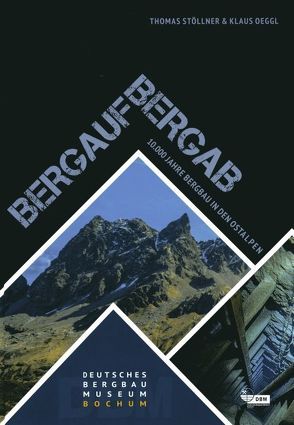
The volume with scientific contributions on the exhibition is organised identical to the short guide. It contains a foreword, a welcoming address, 112 papers, a list of authors and of scientific review. These aspects may serve as examples for the wealth of material contained: ore deposits, traffic routes, Alpine transhumant pastoralism, vegetation history and land use, high-altitude hunting, deposits of flint and rock crystal, copper, iron, settlement history, mining, experimental archaeology, smelting, casting, and smithing techniques, dendro-dates, timber and supply for mining areas, meat consumption, elites, cemeteries, salt mines and use of brine, textiles, lead, gold, steel production, mining legislation, toponyms, potstone quarries, the mining book of Schwaz, population dynamics, use and development of forests, charcoal, radon galleries, garnet, and marble. Important sites under consideration are Milland, the Pongau Valley, Schwaz-Brixlegg, Kitzbühel, the Mitterberg Mountain, the Eisenerz Alps, the Trentino, Lower Austria, the Oberhalbstein Valley, Vomp, Hallstatt, the Dürrnberg Mountain, Frög, the High Tauern Alps, Carinthia with the Magdalensberg Mountain, the Montafon Valley, Tyrol, and Southern Tyrol.
Aktualisiert: 2020-11-24
> findR *
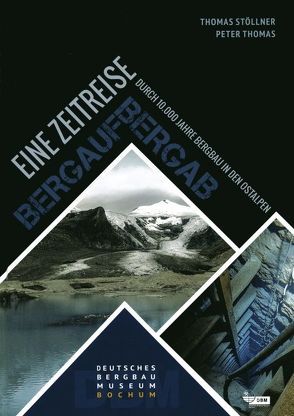
Mining in the Eastern and Southern Alps commenced early in the prehistoric past. Particularly the use of the rich mineral raw materials and geo-ressources such as hunting grounds and pastures stimulated or even caused human occupation of Alpine landscapes. However, the presently dominant understanding of the Alps as a recreation park and a traffic block increasingly supersedes the notion of the ancient coherence of the cultural landscape. In the past, periods of an increased interest in the Alpine region [e.g. in copper, salt or iron] and phases of marginalisation [e.g. in the major contexts of the Imperium Romanum or the present] took turns creating a permanent “uphill” and “downhill” as indicated by the exhibition title. This short guide provides for these and other aspects in its nine chapters dealing with the Alps as a physical space and cultural area, with geology and mining, copper, salt, the Romans in the Alps, the Medieval struggle for droits de régale, mining as a public task in Early Modern times, and the question of what remains and will remain of all this in the present and future. The volume is printed in colour throughout and ends with registers of authors and lenders.
Aktualisiert: 2022-09-17
> findR *
Aktualisiert: 2021-12-30
> findR *
Aktualisiert: 2021-12-30
> findR *
Aktualisiert: 2019-01-04
> findR *
Aktualisiert: 2021-12-30
> findR *
MEHR ANZEIGEN
Bücher von Stöllner, Thomas
Sie suchen ein Buch oder Publikation vonStöllner, Thomas ? Bei Buch findr finden Sie alle Bücher Stöllner, Thomas.
Entdecken Sie neue Bücher oder Klassiker für Sie selbst oder zum Verschenken. Buch findr hat zahlreiche Bücher
von Stöllner, Thomas im Sortiment. Nehmen Sie sich Zeit zum Stöbern und finden Sie das passende Buch oder die
Publiketion für Ihr Lesevergnügen oder Ihr Interessensgebiet. Stöbern Sie durch unser Angebot und finden Sie aus
unserer großen Auswahl das Buch, das Ihnen zusagt. Bei Buch findr finden Sie Romane, Ratgeber, wissenschaftliche und
populärwissenschaftliche Bücher uvm. Bestellen Sie Ihr Buch zu Ihrem Thema einfach online und lassen Sie es sich
bequem nach Hause schicken. Wir wünschen Ihnen schöne und entspannte Lesemomente mit Ihrem Buch
von Stöllner, Thomas .
Stöllner, Thomas - Große Auswahl an Publikationen bei Buch findr
Bei uns finden Sie Bücher aller beliebter Autoren, Neuerscheinungen, Bestseller genauso wie alte Schätze. Bücher
von Stöllner, Thomas die Ihre Fantasie anregen und Bücher, die Sie weiterbilden und Ihnen wissenschaftliche Fakten
vermitteln. Ganz nach Ihrem Geschmack ist das passende Buch für Sie dabei. Finden Sie eine große Auswahl Bücher
verschiedenster Genres, Verlage, Schlagworte Genre bei Buchfindr:
Unser Repertoire umfasst Bücher von
- Stollorz, Volker
- Stollowsky, Lili
- Stollreiter, Anke
- Stollreiter, Eva
- Stollreiter, Marc
- Stollsteiner, Mariott
- Stollsteiner, Mariotte
- Stollt, Guido
- Stollt, Michael
- Stollwerck, Christoph
Sie haben viele Möglichkeiten bei Buch findr die passenden Bücher für Ihr Lesevergnügen zu entdecken. Nutzen Sie
unsere Suchfunktionen, um zu stöbern und für Sie interessante Bücher in den unterschiedlichen Genres und Kategorien
zu finden. Neben Büchern von Stöllner, Thomas und Büchern aus verschiedenen Kategorien finden Sie schnell und
einfach auch eine Auflistung thematisch passender Publikationen. Probieren Sie es aus, legen Sie jetzt los! Ihrem
Lesevergnügen steht nichts im Wege. Nutzen Sie die Vorteile Ihre Bücher online zu kaufen und bekommen Sie die
bestellten Bücher schnell und bequem zugestellt. Nehmen Sie sich die Zeit, online die Bücher Ihrer Wahl anzulesen,
Buchempfehlungen und Rezensionen zu studieren, Informationen zu Autoren zu lesen. Viel Spaß beim Lesen wünscht Ihnen
das Team von Buchfindr.